
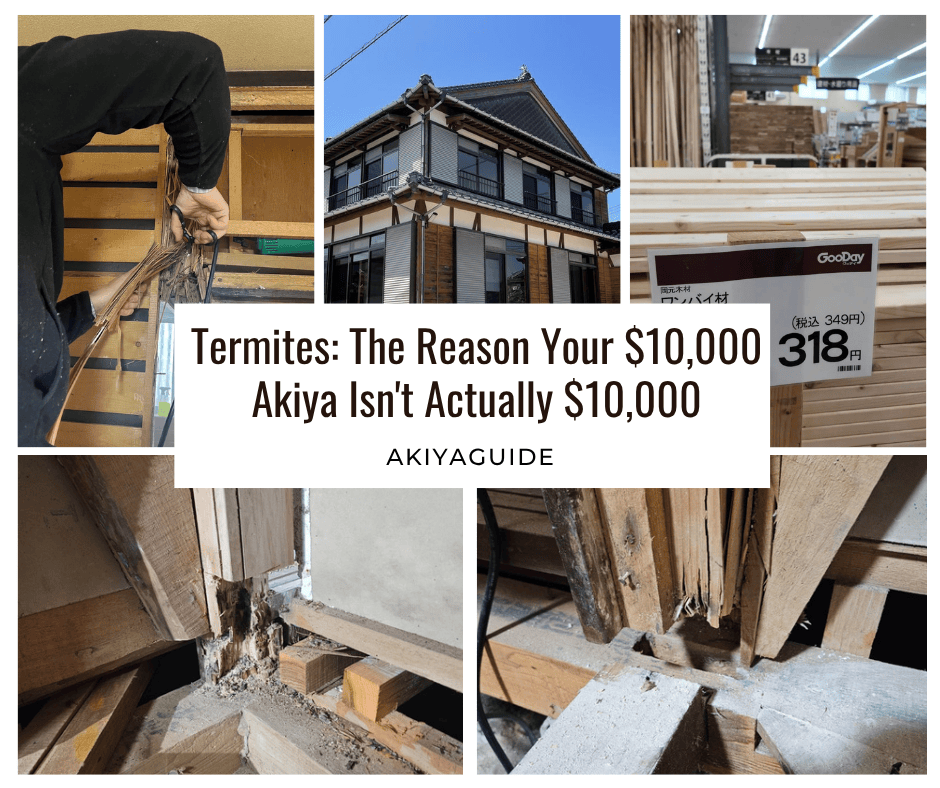
In the world of Japanese renovation, the question is rarely whether a house has dealt with termites, but rather how much damage they have caused and whether the colony is still active. That’s the truth nobody puts in the listing photos, and it’s the first thing I tell anyone who messages me excited about a cheap house they found online.
Japan’s high humidity combined with almost everything being built out of wood creates the perfect environment for them. You will primarily encounter two types.
The most damaging are the subterranean termites. Sometimes called wet-wood termites. They live in the soil and need constant moisture, and because they can’t tolerate sunlight or high temperatures, they build sand tunnels: thin, mud-colored tubes climbing up your foundation to reach the beams above. Generally, they eat their way up from the bottom of the house to about 1.5 meters. The exception is a roof leak, because if water is traveling down inside a wall, they’ll follow that moisture trail straight to the attic, well past their usual limit.
The second type is the drywood termite. These are more localized and can live entirely inside a single beam without ever touching the soil. Because they leave no sand tunnels on the foundation, they’re much harder to catch on a casual walk-through.
How to actually check
Start by lifting the tatami mats, since they’re usually laid directly over the floorboards and hide the most vulnerable part of the structure. Take a screwdriver or the back of a hammer and tap every vertical beam you can find. A healthy beam gives a solid, bright clink. A compromised one sounds dull or hollow. In the worst infestations, the termites have eaten the interior grain completely, leaving only a paper-thin outer shell. I’ve seen beams that could be pulled apart by hand like wet cardboard.
Fixing it
If you find damage, the repair has to be methodical. First, you shore up the floor or roof with adjustable props to take the weight off the compromised section. Only then can you cut out the rotten part. Replacement beams, usually 10cm thick, run about ¥3,000 (roughly $20) for a 3-meter length at a home center like Good Day or Nafco.
Before putting the new wood in place, treat it with anti-termite chemicals as a large can costs ¥2,500–¥5,000 and protects for about five years. For anything more serious, a professional company can run biological control using natural termite predators, which generally costs around ¥100,000 (about $650). That’s a price worth paying to make sure the skeleton of your house is actually secure before you spend a single yen on interior finishes.
Don’t tear out the closets
Once we started replacing beams, I’ll admit the instinct was to keep going. Rip out walls, open the place up, make it feel more Western. We recommend resisting that urge. In a Japanese wooden home, the built-in closets (oshi-ire) and the small interior walls are frequently part of the house’s seismic bracing. They give the house its shear strength, it is what keeps it from folding sideways in an earthquake. Move them without an architect’s sign-off, and you’re not renovating anymore; you’re building a death trap with better wallpaper.
The most successful renovations are the ones that work with the original layout. Clean the wood, fix the leaks, keep the termites at bay, and let the house breathe. Give it a dry foundation and a light roof, and it’ll stand for another century.
At the end of the day, termites aren’t the villain of this story: they’re just part of what a $10,000 house usually costs you, printed in fine wood grain instead of on the listing page. Once you know what to look for and what it takes to fix, that “too good to be true” price starts making sense, and so does the house. That’s really what this whole renovation came down to for us: not avoiding the problems, but knowing them well enough to not be afraid of them.
 Akiya Guide
Leave a comment